👼 The Guardian Goddess of Childbirth '삼신할머니' | TOPIK 1,2 level grammar
삼신할머니 신화 (The Legend of Samshin Halmoni)👶
The Guardian Goddess of Childbirth and Child Rearing삼신할머니는 한국 전통 신화에서 생명의 탄생과 아이의 건강한 양육을 관장하는 신성한 수호신입니다. 잉태부터 출산, 그리고 아이가 일곱 살이 될 때까지 삶의 모든 순간을 축복하고 보호하는 삼신할머니 이야기를 통해, 생명 존중의 한국 문화와 '점지하다' [jeom-ji-ha-da], '보호하다' [bo-ho-ha-da], '양육하다' [yang-yug-ha-da] 등 필수 한국어 어휘와 고급 문법을 이중언어로 마스터합니다.
Samshin Halmoni is the sacred guardian deity who governs the birth of life and healthy child rearing in Korean traditional mythology. Through her story of blessing and protecting children from conception to age seven, we explore the Korean cultural reverence for life alongside essential TOPIK vocabulary and syntax in bilingual Korean-English.
- 1. 잉태와 점지 Bestowal of Life
- 2. 탄생과 몽고반점 Birth & Mongolian Spot
- 3. 삼신상과 수호 Altar & 7-Year Protection
📖 삼신할머니 이야기 (The Narrative & Context)
옛날 한국인들은 아이가 하늘의 신성한 인연을 통해 세상에 태어난다고 믿었으며, 이를 주관하는 분이 바로 '삼신할머니'였습니다.
In ancient Korea, people believed that babies came into the world through a sacred heavenly destiny, and the deity presiding over this was 'Samshin Halmoni'.
🔊 English Phonetics: [Yet-nal Han-gug-in-deul-eun a-i-ga ha-neul-ui sin-seong-han in-yeon-eul tong-hae se-sang-e tae-eo-nan-da-go mit-eot-seo-myeo, i-reul ju-gwan-ha-neun bun-i ba-ro Sam-sin-hal-mo-ni-yes-seum-ni-da.]삼신할머니는 간절히 자식을 바라는 부모에게 아기의 영혼을 선사하고, 어머니의 태안에서 생명이 무사히 자라도록 점지해 [jeom-ji-hae] 줍니다.
Samshin Halmoni bestows the soul of a child upon parents who earnestly long for one, ordaining that the new life grows safely within the womb.
🔊 English Phonetics: [Sam-sin-hal-mo-ni-neun gan-jeol-hi ja-sig-eul ba-ra-neun bu-mo-e-ge a-gi-ui yeong-hon-eul seon-sa-ha-go, eo-meo-ni-ui tae-an-e-seo saeng-myeong-i mu-sa-hi ja-ra-do-rok jeom-ji-hae jum-ni-da.]아기가 태어날 때 어머니 밖으로 빨리 나오도록 삼신할머니가 엉덩이를 찰싹 때려주는데, 이때 생긴 자국이 바로 신생아의 '몽고반점'이라는 재미있는 전설이 있습니다.
According to a delightful legend, when a baby is about to be born, Samshin Halmoni slaps its bottom to encourage it to come out quickly, leaving the blue 'Mongolian birthmark'.
🔊 English Phonetics: [A-gi-ga tae-eo-nal ttae eo-meo-ni bakk-eu-ro ppal-ri na-o-do-rok Sam-sin-hal-mo-ni-ga eong-deong-i-reul chal-ssak ttae-ryeo-ju-neun-de, i-ttae saeng-gin ja-gug-i ba-ro sin-seng-a-ui mong-go-ban-jeom-i-ra-neun jae-mi-it-neun jeon-seol-i it-seum-ni-da.]아기가 태어나면 가족들은 따뜻한 미역국과 쌀밥으로 '삼신상'을 차려 삼신할머니에게 감사 인사를 올리고, 아이가 일곱 살이 될 때까지 잔병치레 없이 자라도록 기원했습니다.
Upon the baby's birth, families prepared a 'Samshin Altar' with warm seaweed soup and white rice to thank her, praying that the child would grow free of illness until seven years of age.
"우리 아기 젖 잘 먹고 쑥쑥 자라게 해 주셔서 감사합니다, 삼신할머니."
"Thank you, Samshin Halmoni, for helping our baby feed well and grow healthy and strong."
📺 Live Video Exploration (라이브 영상 탐색)
한국 신화 속 삼신할머니가 가정을 축복하고 아이를 수호하는 모습을 담은 애니메이션 영상을 감상해 보세요.
Watch the video clip illustrating how Samshin Halmoni bestows children upon families and protects growing souls in Korean myth.
🔬 Lexical Field Theory Deep Dive (어휘장 이론 분석)
신화의 핵심 개념인 '점지하다' [jeom-ji-ha-da]의 의미 체계와 연관 어휘 네트워크를 분석합니다.
Explore the semantic field structure of the core mythic concept '점지하다' [jeom-ji-ha-da] (To Ordain Birth) and its relational lexical ecosystem.
Core Target Lexeme: 점지하다 [jeom-ji-ha-da]
(For a deity or divine power to bestow a child upon humans.)
📚 High-Yield Vocabulary Masterclass (핵심 어휘)
삼신할머니 신화에서 추출한 핵심 어휘를 문맥과 함께 학습하세요.
Master core verbs and nouns derived from the Samshin Halmoni narrative to enhance your TOPIK competency.
1. 점지하다 [jeom-ji-ha-da]
Samshin Halmoni bestowed a precious baby upon the earnest parents.
🔊 Phonetics: [Sam-sin-hal-mo-ni-ga gan-jeol-han bu-mo-e-ge gwi-han a-gi-reul jeom-ji-hae ju-syeos-seum-ni-da.]
2. 보호하다 [bo-ho-ha-da]
The deity in mythology protects the child nearby so that it grows up healthy.
🔊 Phonetics: [Sin-hwa sok sin-eun a-i-ga geon-gang-ha-ge ja-ra-do-rok yeop-e-seo bo-ho-ham-ni-da.]
3. 양육하다 [yang-yug-ha-da]
Parents must nurture their children uprightly with love and devotion.
🔊 Phonetics: [Bu-mo-neun sa-rang-gwa jeong-seong-eu-ro a-gi-reul ba-reu-ge yang-yug-hae-ya ham-ni-da.]
✍️ Advanced Syntax Structural Blueprint (핵심 문법)
한국 설화와 문화적 서사에서 주로 사용되는 고급 연결 어미 문법 구조를 학습합니다.
Analyze the key connective structures utilized in Korean folklore and cultural narratives.
문법 기능: 긍정적인 결과나 원인을 나타낼 때 사용하는 표현 ('덕분에' = thanks to).
Functional Analysis: Causative expression meaning "thanks to" or "as a positive result of."
실전 적용: 삼신할머니께서 돌보아 주신 덕분에 아이가 건강하게 자랐습니다.
Implementation: Thanks to Samshin Halmoni looking after the child, the baby grew up healthy.
문법 기능: 다른 사람을 위해 어떠한 행동을 은혜롭게 수행함을 나타내는 보조동사 구조.
Functional Analysis: Auxiliary verb structure indicating performing an action for someone else's benefit.
실전 적용: 신은 세상의 모든 아기들에게 생명의 축복을 선사해 줍니다.
Implementation: The deity bestows the blessing of life upon all babies in the world.
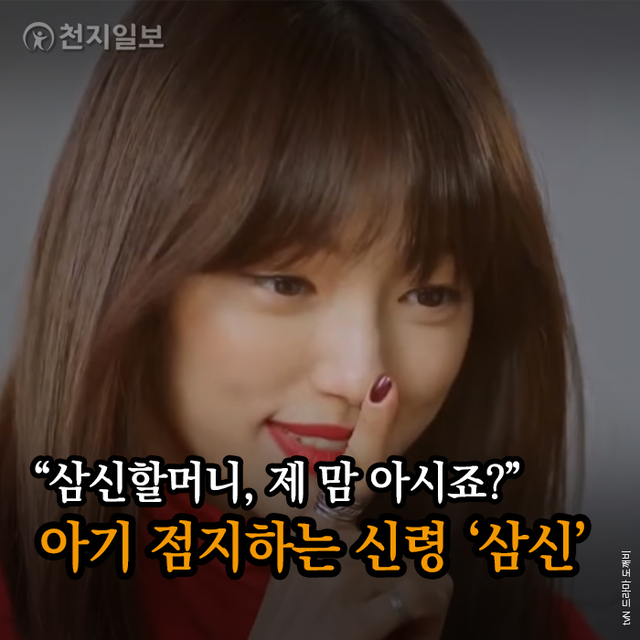
(Samshin Halmoni character depiction in K-Drama <Goblin>)
🎓 Real Exam TOPIK Assessment (TOPIK 실전 연습문제)
실제 TOPIK I/II 기출 문제 유형을 바탕으로 본문의 어휘와 문화 개념을 평가하세요.
Test your understanding of the vocabulary and cultural concepts introduced in this lesson based on authentic TOPIK exam patterns.
Q1. [TOPIK II 어휘 유형] 다음 빈칸에 들어갈 가장 적절한 어휘를 고르십시오.
Select the most appropriate vocabulary for the blank below.
"삼신할머니는 아이가 없는 가정에 귀한 생명을 ( ) 유아의 성장 과정을 따뜻하게 보호한다."
"Samshin Halmoni ( ) a precious life upon a childless family and warmly protects the child's growth process."
💡 정답 및 해설: 정답은 ②번입니다. 신령이 아이의 생명을 부여한다는 뜻의 '점지하다'가 가장 자연스럽습니다.
💡 Explanation: The correct answer is ②. 'Jeom-ji-ha-da' means a deity ordaining or bestowing a child, which perfectly fits the mythic narrative.
Q2. [TOPIK I/II 읽기 유형] 한국 신화에서 신생아의 '몽고반점'이 생기는 원인으로 올바른 것을 고르십시오.
According to Korean mythology, select the correct reason for the presence of a newborn's Mongolian spot.
💡 정답 및 해설: 정답은 ①번입니다. 한국 전설에서는 삼신할머니가 아이의 출산을 촉진하기 위해 엉덩이를 때려 몽고반점이 생겼다고 봅니다.
💡 Explanation: The correct answer is ①. In Korean folklore, Samshin Halmoni slapped the baby's bottom to speed up birth, leaving the blue mark.
📚 Top5 Korean study essential
[추천 필수 한국어 학습 콘텐츠 Top 5 / Recommended Korean Study Essentials]
-
1. 🎥 [직장인들 시즌3] 시니어 인턴 등장 & 비즈니스 한국어 레슨
[Office Workers S3] Senior Intern & Business Korean Lesson
[KO] 웹예능 '직장인들 시즌3'의 시니어 인턴 에피소드를 활용하여 실전 회사 예절, 핵심 어휘 '직장(Workplace)'의 어휘장 구조, TOPIK 필수 문법(-아/어 보다, -(이)나, -(으)ㄹ 수 있다/없다)을 체계적으로 다룹니다.
[EN] Learn practical office etiquette, structured lexical analysis of 'Workplace (직장)', and essential TOPIK grammar through the 'Office Workers Season 3' senior intern episode.
-
2. 🎬 영화 <가능한 사랑>으로 배우는 감정 표현 & 대화 한국어
Korean Lesson with Movie <Possible Love>: Emotional Expressions & Dialogue
[KO] 한국 영화 <가능한 사랑>의 장면과 대사를 바탕으로 뉘앙스 있는 감정 표현, 일상 실전 대화 문형 및 TOPIK 응용 문법을 정밀 학습합니다.
[EN] Master subtle emotional expressions, conversational daily phrases, and practical Korean grammar using lines and context from the movie 'Possible Love'.
-
3. 📊 TOPIK II 그래프 해석 퀴즈: 헌혈 동향 분석
TOPIK II Graph Interpretation Quiz: Blood Donation Trends
[KO] TOPIK II 읽기·쓰기 영역 출제 필수 주제인 '헌혈 동향' 통계 그래프를 해석하고 변화 추이, 비율 비교 표현, 관련 필수 통계 어휘를 퀴즈 형식으로 점검합니다.
[EN] Practice TOPIK II reading and writing graph analysis skills with real statistics on blood donation trends, data comparison terms, and statistical vocabulary quizzes.
-
4. 🌕 초급자를 위한 추석 명절 문화 & TOPIK 어휘 가이드
Beginner's Guide to Chuseok Holiday Culture & TOPIK Vocabulary
[KO] 한국의 대표적 명절인 추석의 풍습, 명절 주요 덕담 표현, 초급 TOPIK 필수 어휘를 함께 실어 한국 어학 능력과 문화적 배경지식을 동시에 구축합니다.
[EN] Discover traditional Korean Chuseok (Thanksgiving) customs, festive greetings, and fundamental TOPIK vocabulary designed specifically for beginner learners.
-
5. 📝 한국어 정도 부사 '너무'의 올바른 용법 & TOPIK 문법
Practical Usage of Degree Adverb 'Neomu' & TOPIK Grammar
[KO] 정도 부사 '너무'의 긍정/부정적 상황별 쓰임새 차이, 구어체와 격식체에서의 올바른 표기법, TOPIK 문법 시험에서의 핵심 출제 포인트를 분석합니다.
[EN] Understand the nuance, positive and negative contexts, formal vs. informal usage, and TOPIK exam applications of the degree adverb 'Neomu' (too/very).


댓글
댓글 쓰기